
The Apple M5 chip has officially arrived — powering the latest iPad Pro, Vision Pro, and entry-level MacBook Pro models. Apple Inc. announced these refreshed devices just ahead of the crucial holiday shopping season, promising significant boosts in performance, artificial intelligence processing, and energy efficiency.
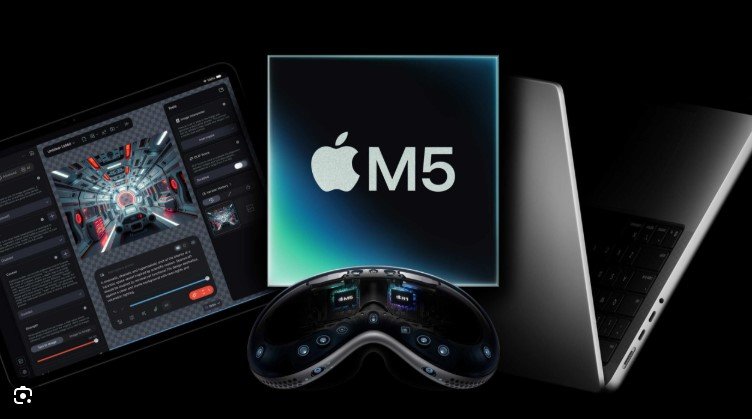
Although the new lineup looks similar to the previous generation, Apple’s internal upgrades mark a major leap in computing power and user experience. The introduction of the M5 chip cements Apple’s continued push toward self-developed silicon, which has redefined the company’s hardware strategy since the debut of the M1 chip in 2020.
Apple Expands M5 Chip Lineup Across Devices
Apple revealed that the iPad Pro, Vision Pro, and MacBook Pro would now run on the company’s cutting-edge M5 chip, replacing older M-series processors. This unified chip update ensures faster graphics rendering, smarter AI functions, and overall smoother performance across devices.
Despite the performance improvements, Apple confirmed that prices remain unchanged:
-
iPad Pro starts at $999
-
MacBook Pro begins at $1,599
-
Vision Pro headset continues at $3,499
The iPad Pro also introduces the N1 wireless chip and C1X modem, while the Vision Pro features a newly designed Dual Knit Band head strap to improve comfort during extended use.
All three devices are available for pre-order now and will hit stores on October 22 — coinciding with the delayed China launch of the iPhone Air.
iPad Pro with M5 Chip: Power and Precision
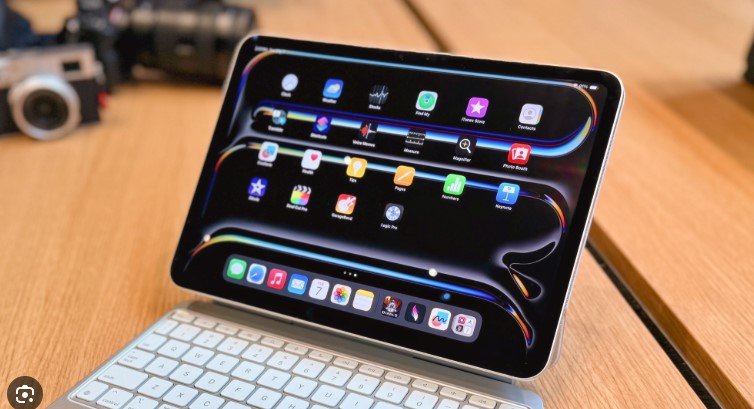
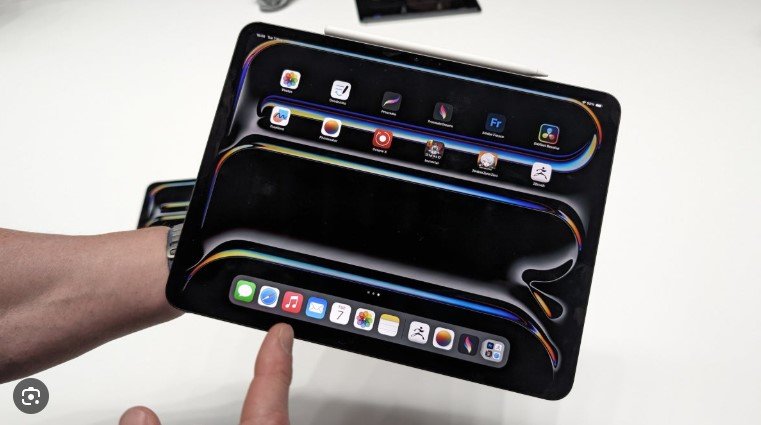
The latest iPad Pro with M5 chip sets a new benchmark for tablet performance. Apple claims the M5 delivers 3.5 times better AI performance than the previous M4 version. This performance surge positions the iPad Pro as a viable replacement for many high-end laptops, appealing to creative professionals and multitaskers alike.
Paired with iPadOS 26, which introduced long-requested multitasking features, the M5 chip allows users to seamlessly manage demanding apps and workflows. Whether it’s 4K video editing, 3D design, or machine learning, the M5-powered iPad Pro handles it with ease.

The tablet maintains its slim, sleek design and sports a tandem OLED display, which combines multiple layers for improved brightness and color accuracy. The 11-inch model starts at $999, while the 13-inch version begins at $1,299.
Additionally, Apple unveiled a black Magic Keyboard for the iPad Air — previously available only in white — giving users more aesthetic choices.
Apple hopes the new iPad lineup will reignite demand after a soft sales quarter. Many consumers were reportedly holding off purchases in anticipation of this update.
Vision Pro: Enhanced by the M5 Chip
Apple’s Vision Pro headset also gets a notable upgrade with the M5 chip, delivering smoother performance, improved visuals, and longer battery life. The previous M2 processor, now three years old, had started to show its age — and the new chip breathes fresh life into Apple’s mixed-reality device.
The M5 chip enhances the augmented reality (AR) experience, reducing lag and allowing for richer, more immersive content. The Vision Pro’s Dual Knit Band head strap provides improved comfort with both upper and lower supports, addressing user complaints about weight and fatigue from the earlier version.
While app availability for the Vision Pro remains limited, Apple continues to position it as a professional-grade device, ideal for businesses, designers, and educators seeking immersive visual tools.
However, the company has reportedly paused plans for a lighter, cheaper Vision Pro model, choosing instead to focus on developing smart glasses to compete with Meta’s Ray-Ban Display Glasses, which have recently impressed tech reviewers.
MacBook Pro Joins the M5 Era
The 14-inch MacBook Pro becomes Apple’s first laptop to feature the M5 chip, marking another milestone in its transition from Intel processors. Apple promises significant performance boosts for users upgrading from M1 or Intel models — particularly in AI-driven tasks, graphics-heavy workflows, and power efficiency.
The MacBook Pro maintains its familiar aluminium design, available in silver and black, with optional anti-glare displays.
In Apple’s most recent quarter, the Mac lineup generated $8.05 billion in revenue, surpassing Wall Street’s $7.3 billion estimate. The introduction of the M5-powered model aims to sustain that momentum through the holiday season and into early 2026.
Looking ahead, Apple is developing M5 Pro and M5 Max versions of the chip, set to power the high-end 14-inch and 16-inch MacBook Pros early next year. These models are expected to bring even greater performance for professionals in video editing, software development, and design.
Apple M5 Chip: The Future of Intelligent Computing
The Apple M5 chip represents a leap in Apple Silicon evolution. Built on advanced architecture, it improves AI task handling, power efficiency, and multitasking capabilities. Apple’s goal is to deliver machine learning acceleration directly on-device, reducing reliance on cloud computing and enhancing privacy.
Key improvements include:
-
Up to 30% faster CPU performance than the M4
-
Advanced neural engine for AI-driven workflows
-
Improved GPU for graphics-intensive applications
-
Optimized battery efficiency for longer device usage
These upgrades make the M5 not just faster — but smarter. Apple is clearly investing in AI-first design, preparing its hardware ecosystem for the next generation of intelligent applications.
Apple’s Expanding Product Roadmap
Beyond the M5-powered devices, Apple’s roadmap includes several exciting upcoming releases:
-
M5 Pro and M5 Max MacBook Pros (early next year)
-
AirTag 2 with enhanced precision tracking
-
HomePod mini and Apple TV refreshes
-
iPad Air and entry-level iPad updates
-
A revamped Siri smart home hub
The company continues to build momentum after unveiling the iPhone 17 and iPhone Air last month, alongside upgraded AirPods and Apple Watches.
These consistent product rollouts highlight Apple’s long-term strategy — expanding its hardware ecosystem while refining each device’s intelligence and performance through in-house chip innovation.
Apple’s Vision for a Unified Ecosystem
With the Apple M5 chip now at the heart of its major devices, Apple is reinforcing its ecosystem’s seamless integration. The goal is to ensure that every product — from iPhone to MacBook to Vision Pro — communicates effortlessly, sharing processing capabilities, AI learning, and cloud data through unified chip architecture.
This alignment supports Apple’s broader shift toward on-device AI, sustainability, and energy-efficient design — critical priorities for the company as it navigates growing competition from Qualcomm, Intel, and Meta.
Conclusion: Apple M5 Chip Ushers in a New Era of Smart Devices
The introduction of the Apple M5 chip is more than just another update — it’s a major step in Apple’s ongoing journey to redefine performance, intelligence, and user experience across devices.
From the iPad Pro’s unmatched processing power to the Vision Pro’s smoother AR experience and the MacBook Pro’s enhanced multitasking, Apple is demonstrating that innovation still lies at the core of its DNA.

With the holiday season approaching, these new launches are expected to drive strong sales while laying the foundation for Apple’s AI-driven future. The M5 chip has officially set the stage for the next wave of smart, connected, and efficient Apple devices.